
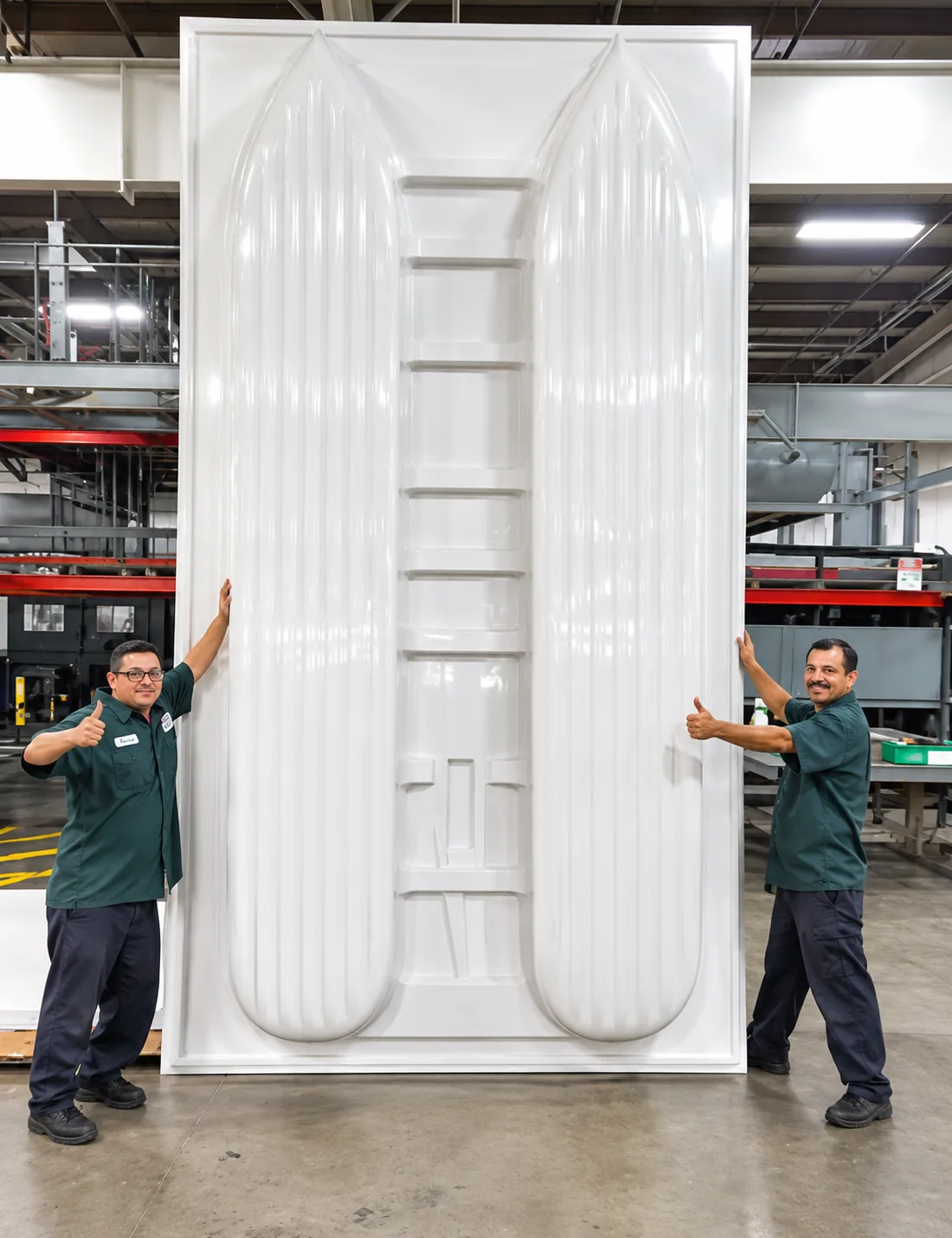
Heavy gauge thermoforming as a manufacturing operation relies on material thickness to create durable plastic parts. The relationship between this type of thermoforming and material thickness are connected in two ways: thickness influences how finished parts perform and the reliability of how the sheet can be heated, formed, and cooled.
Allied Plastics details this relationship by sharing how material thickness impacts performance in heavy-gauge thermoforming.
Starting Thickness vs Finished Thickness
Material thickness in heavy gauge thermoforming operations face two different considerations: the starting thickness and the finished thickness. A sheet’s starting gauge doesn’t represent the thickness throughout a component once operations have finished.
Thickness distribution is dependent on interacting factors such as:
- Draw depth and the surface area the sheet needs to cover
- Corner radii, transitions, and other geometry considerations
- Sheet-temperature uniformity
- Mold contact and production timing
- Use and movement of a plug assist
It’s not enough to simply add thickness to a sheet as that might leave excess material. Instead, improving material distribution will lead to improved thickness rather than increasing the starting gauge.
How Thickness Impacts Part Performance
Above all, material selection and material thickness are both important and impact part performance. A material may be thick, but that doesn’t account for other qualities such as impact resistance, fire resistance, surface finish, or any other application requirements.
Consider this chart and the relationships that highlight thickness’s distribution over performance and costs.
| Performance Factor | Effect of Material Thickness | Design Implication |
|---|---|---|
| Rigidity and load support | Thin local sections are more vulnerable to bending, buckling, and mechanical failure | Evaluate the thickness remaining in load-bearing walls and corners instead of relying on nominal sheet gauge |
| Impact / handling durability | Highly thinned regions can become spots for cracking or puncture | Specify and inspect minimum thickness in impact-prone areas |
| Dimensional stability | Uneven thickness creates uneven cooling, which can lead to warpage | Control thickness distribution and cooling |
| Weight / material consumption | Increasing starting gauge adds material throughout the sheet, including areas that don’t require reinforcement | Use minimum gauge that consistently meets finished part requirements |
The Effects of Thickness on Heavy-Gauge Manufacturing
When electing for heavy gauge operations, the sheet’s surface can reach its forming temperature before the core is properly heated. It’s more important to monitor the heating time and place process controls over temperature uniformity, and equate it to the gauge, rather than increasing heating power. A sheet that’s not heated properly will stretch improperly, which makes it harder to achieve consistent wall thickness.
It’s important to note that a thicker starting sheet doesn’t automatically erase thinning in deep draws or difficult geometries. Maintaining design principles such as giving generous radii, smooth depth transitions, and allowing for forming assistance can help how the material reaches difficult areas.
A final consideration is the complete opposite of heating: cooling. The same way it takes thicker sections longer to heat up, it also takes longer for them to cool down and properly form. Uneven cooling leads to distortion and that can lead to flatness and assembly problems.
Making the Right Choice
When it comes down to it, selection the right material thickness for heavy gauge thermoforming operations can be broken down by starting at the finished part requirements and working backward.
What’s the required performance of your part? This should include considerations on loads, impact exposure, dimensional requirements, and any relevant material properties. Where are the critical locations? Clearly identify deep corners, transitions, and load-bearing walls.
Can forming-related thinning be properly estimated? Use geometry, draw ratios, and the specified thermoforming process as guides to gather a factual estimate. Select a starting gauge and production process that retains enough material in specified locations.
And lastly, how does measured finished thickness and testing both verify and represent formed parts?
When answers to these questions are gathered, the right material thickness should appear.
Allied Plastics: Experts in Heavy Gauge Thermoforming Solutions
Allied Plastics are industry experts in heavy-gauge thermoforming solutions and are a proud American manufacturer located in Twin Lakes, Wisconsin. Since 1995, our team of operators, engineers, and management have poured our combined knowledge and capabilities into being one of the leading thermoforming manufacturers in the country.
Our heavy gauge capabilities include vacuum forming, twin sheeting and pressure forming custom parts in sizes up to 9 ft x 14 ft x 60” depth of draw. Starting sheet thicknesses can range from .060” – .550”. Our team has experience in vacuum forming a wide variety of materials, such as HMWPE, HDPE, TPO, ABS, PP, and PS.
We hold ourselves to the highest standards when it comes to quality management systems and we’ve held both an ISO 9001 and ISO 14001 certification for decades now.
When your project demands heavy gauge thermoforming operations, there’s one team you should rely on. Contact Allied Plastics today to set up an initial consultation and discover the difference we can make for you.