Thermoforming secondary operations, including trimming and finishing, hold more weight than merely giving a formed part its final shape and a nice visual aesthetic.
From assembly-readiness and surface performance, to dimensional consistency throughout the shape, secondary operations matter more than most think. Allied Plastics highlights the importance of thermoforming secondary operations and states the case on why they matter for all thermoforming programs.
Trimming Defines the Finished Shape
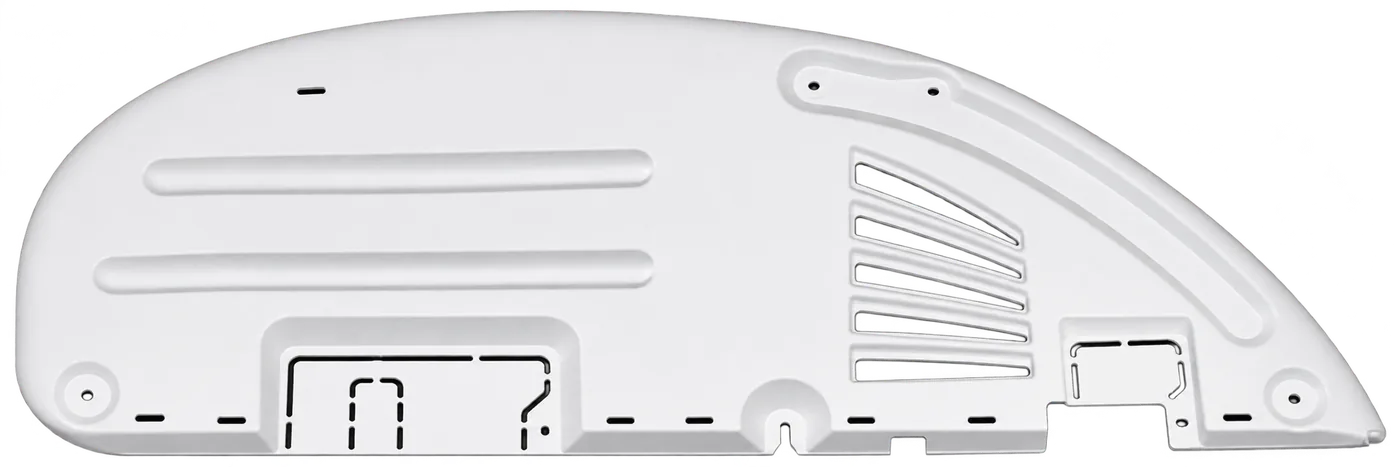
When the thermoforming process has completed its initial steps, there is excess material that’s formed around the component, and it needs trimmed in order for the final shape to appear. Trimming can also create intentional holes, slots, vents, windows, and other openings that are required for assembly operations.
Both forming and trimming need to support the same dimensional requirements of the designed shape and they share a responsibility in defining the finished shape.
Viewing and Choosing the Right Trimming Method
There are multiple trimming methods available for thermoforming secondary operations, and no one method is better than the other. It all depends on part geometry, material thickness, production quantity, dimensional requirements, and more.
| Method | Traditional Fit | Main Consideration |
|---|---|---|
| Manual trimming | Prototypes, low quantities, simple shapes | Low initial tooling investment, results depend on operator skill |
| Die cutting | Thinner materials, simpler outlines, higher production quantities | Efficient for suitable applications, but, part location and tooling influence dimensional consistency |
| CNC trimming | Complex outlines, multiple openings, controlled assembly features | Programmable, repeatable cutting, but, performance is dependent on tooling, part support, and process setup |
In heavy-gauge thermoforming operations, like what Allied Plastics specializes in, five-axis CNC trimming reaches features on angled or curved surfaces. It’s important to note that machine capability alone doesn’t establish finished-part accuracy. This is only achieved when the formed component is located and support consistently.
Precision Depends on More Than Just the Cutter
Even though trimming is one of the last steps in the thermoforming process, it’s possible for inconsistent parts to be produced if the incoming shapes, locating surfaces, or fixtures vary. Repeatable trimming is the goal, and that goal is much more achievable through process controls placed during actual thermoforming where repeatability and datum strategy are accounted for.
Consider these three factors for attention. Part support, cooling and shrinkage, and feature references. Part support is a factor that’s geared toward a fixture being supported by the formed shape consistently. Cooling and shrinkage refer to that if parts are trimmed while still warm, dimensions can change as cooling continues. And feature references apply to hole locations and trim boundaries, and how they need to relate to purposeful drawing datums.
Finishing is More Than Appearance
It’s a common thought that when discussing finishing that it’s about how a thermoformed part looks. While that may be true on the surface, finishing operations are much than just about appearance.
Edge refinement, hardware installation, bonding, gasket application, and assembly are all under the umbrella of finishing and dictate what a part can do, rather than how it looks.
Edge Quality
Items such as burrs, rough cuts, fine plastic strands, and stress whitening can undermine quality of a seemingly acceptable part. That’s why edge condition matters. Especially at visible boundaries and functional assembly interfaces. Edges serve a purpose and the dimensional inspection of an edge needs to remain separate from the cosmetic inspection.
Assembly Readiness
Finishing services also extend to assembly operations as bonded brackets, threaded inserts, fasteners, and gaskets transform a formed part into a whole assembly.
Surface Performance
Of course, thermoforming secondary operations do extend to appearances, but it’s more than how a part looks. It also extends to how the part’s appearance performs. Specific paints and coatings can provide color, text, or application-specific performance.
Partner With Allied Plastics for Thermoforming Secondary Operations and Manufacturing Capabilities
Allied Plastics is among the industry leaders in heavy-gauge custom thermoforming manufacturing operations. At Allied Plastics, our thermoforming operations support vacuum forming, twin sheeting and pressure forming custom parts in sizes up to 9 ft x 14 ft x 60” depth of draw. Starting sheet thicknesses can range from .060” – .550”. Our team has experience in vacuum forming a wide variety of materials, such as HMWPE, HDPE, TPO, ABS, PP, and PS.
As far as thermoforming secondary operations, we can handle that too. Our precision CNC trimming using 12 5-axis machines and five robotic trimming systems. This technology ensures consistent, high-quality edge finishing for even the most complex geometries. We maintain tight tolerances across production runs, delivering components that meet your exact specifications every time.
Other finishing and secondary operations include: surface treatments, texture application, and specialized edge work, assembly, decal application, kitting, packaging, and bar coding.
When your thermoforming manufacturing program needs more than just the production capabilities, our team at Allied Plastics is here for you. Contact us today for more information about our thermoforming secondary operations and let’s partner to create something great.