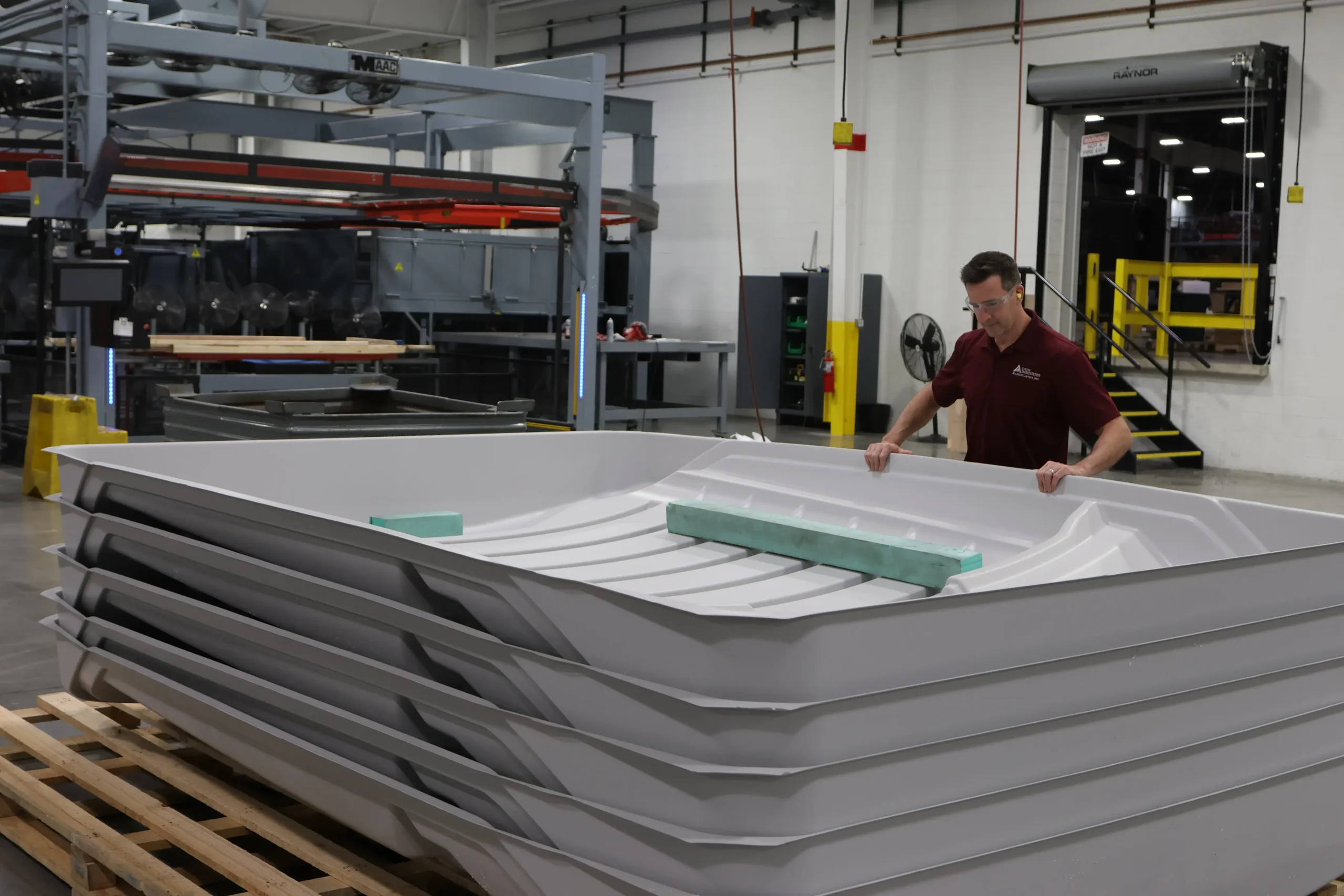
Large part thermoforming typically involves heavy-gauge sheet and significant draw depth. It is commonly selected for oversized industrial components where structural integrity, durability, and production scalability matter.
Applications often include structural housings, large enclosures, protective covers, and other large-format parts that would be cost-prohibitive or impractical to produce through injection molding. For many medium- to heavy-gauge applications, thermoforming offers reduced tooling costs and greater flexibility, particularly when part size increases beyond conventional molding limits.
However, as part size grows, maintaining consistent wall thickness becomes more technically demanding. What works in smaller components does not always translate directly to large part thermoforming at scale. Understanding the factors that influence material distribution — and the manufacturing considerations that help control it — is critical to achieving repeatable performance in production.
Why Wall Thickness Becomes Harder to Control as Part Size Increases
Wall thickness variation is one of the most common challenges in large-format thermoforming. As sheet size and draw depth increase, material behavior becomes more difficult to predict and control due to a variety of factors:
Material Stretching Across Deep Draws
During forming, heated plastic sheet stretches to conform to the tool surface. In deep-draw applications, material tends to thin at corners, edges, and high-stress transition zones.
This can create distribution imbalances, where certain areas lose structural thickness while other areas remain comparatively thick. In large part thermoforming, even small percentage variations can affect long-term durability and performance.
Heat Distribution Across Large Surface Areas
Uniform heating becomes more complex as sheet size increases. Large sheets are more susceptible to uneven temperature distribution, which can result in inconsistent material flow.
Sheet sag and gravitational influence further complicate forming, especially in heavy-gauge applications where material mass is greater. If heating is not carefully managed, localized thinning or inconsistent forming can occur.
Tool Geometry and Surface Transitions
Tool geometry plays a critical role in material distribution. Sharp radii and abrupt transitions can restrict material flow and increase thinning in specific regions. Gradual transitions, controlled contours, and balanced geometry help improve wall thickness uniformity across the part.
In complex geometries, understanding how material flows across surfaces is essential for maintaining structural integrity.
Cooling and Shrink Variability
Finally, cooling rates also affect final wall thickness and dimensional stability. Differential cooling across large parts can introduce warping or internal stresses. As part size increases, managing shrink behavior becomes increasingly important to ensure consistent performance across production runs.
Engineering Considerations That Improve Thickness Consistency
Maintaining wall thickness in large part thermoforming requires more than simply adjusting forming temperature. It involves coordinated control of materials, heating, tooling, and process validation.
Material Selection for Large Part Thermoforming
Material properties directly influence thickness control. Key considerations include:
- Melt strength
- Elongation characteristics
- Structural performance requirements
- Long-term environmental exposure
Selecting a material aligned with application demands reduces the risk of excessive thinning in critical zones.
Controlled Heating Zones
Zonal temperature management allows manufacturers to apply more heat where additional material flow is needed and less where thinning risk is higher. Controlled heating helps reduce uneven stretching and improves consistency across the sheet prior to forming.
Plug Assist and Pre-Stretch Techniques
Plug assist methods and controlled pre-stretch techniques can mechanically guide material distribution before full vacuum or pressure is applied. This helps control thinning in deep-draw areas and supports more uniform wall thickness across complex geometries.
Tooling Strategy for Uniform Distribution
Tooling strategies should support gradual transitions and balanced material flow. Structural reinforcement zones and thoughtful contour transitions reduce localized thinning and help maintain wall thickness in load-bearing areas.
Process Monitoring and Validation
Thickness consistency improves when forming parameters are monitored and validated before full-scale production. Measuring repeatability, reviewing thickness distribution, and making data-driven adjustments reduce variability and improve long-term production stability.
Scaling from Prototype to Full Production Without Compromising Consistency
A part that performs well in short runs does not automatically maintain the same performance at scale. As production volume increases, additional variables are introduced, including:
- Shift-to-shift variation
- Material lot changes
- Equipment wear
- Environmental fluctuations
Process validation before full-volume production is essential. Monitoring repeatability across shifts and production cycles helps control scrap rates and maintain wall thickness tolerances.
Vertically integrated operations can further support this stability. In-house sheet extrusion, for example, improves control over incoming material thickness and reduces variability introduced by external suppliers.
The Role of Vertical Integration in Maintaining Thickness Control
Wall thickness consistency begins before forming starts. Maintaining sheet consistency prior to forming reduces variability throughout the process. Integrated forming, trimming, and finishing operations reduce handoffs and minimize process variables.
Precision trimming also supports uniform wall distribution by ensuring that final geometry aligns with forming expectations. Fewer transitions between suppliers and processes often translate to greater control and improved repeatability.
Reducing Risk in Large Part Thermoforming Programs
Managing risk in large part thermoforming requires early evaluation and ongoing oversight. Key considerations include:
- Identifying structural load zones early
- Monitoring draw depth constraints
- Aligning material performance with application demands
- Maintaining ongoing quality control throughout production
When these factors are addressed proactively, manufacturers can significantly reduce the likelihood of rework, scrap, and long-term performance issues.
Let’s Talk About Your Large Part Thermoforming Requirements
Allied Plastics specializes in heavy-gauge large part thermoforming for structural and complex industrial components. Our capabilities include large-format forming up to 9’ x 14’, in-house sheet extrusion for improved material control, precision trimming, and integrated finishing.
With experience supporting scalable OEM production programs, we focus on maintaining consistency and repeatability across the full lifecycle of a manufacturing program.
If you’re evaluating large part thermoforming for a structural or complex application, contact Allied Plastics to discuss your production requirements and determine the right approach for maintaining consistency at scale.